
Fairfield County Court Records After a Jail Arrest
After a Fairfield County arrest, two records exist side by side. The custody record sits with the Connecticut Department of Correction. The court record sits with the Judicial Branch. Connecticut has no county jail and no sheriff roster, so custody after a booking runs through the state DOC. Once a person is booked, a State's Attorney reviews the matter and files the charges that proceed in Superior Court. Those filed charges are the court record. They are not always the same as the charges written on the arrest paperwork. A prosecutor can add, drop, reduce, or substitute counts as the case develops.
Keep the two tracks clear. The custody side shows where a person is held and their legal status, and the booking detail lives there. For the roster and custody fields, the jail inmate records page covers the DOC search, and booking photos are explained on the jail mugshots page. The court record is different. It shows the docket, the filed charges, the bond, the hearing dates, and the disposition. An arrest opens that pathway, but the court file is what tracks the case from the first appearance to the final outcome.
How to Find Fairfield County Court Records After an Arrest
Connecticut criminal cases run through the Superior Court. The public route to those court records is the Connecticut Judicial Branch Criminal/Motor Vehicle Case Look-up. It is free and needs no login. The portal carries two distinct searches. One covers pending cases and upcoming dates. The other covers conviction and bond-forfeiture dispositions. A name search works when you lack paperwork. A docket-number search is cleaner when you have a court notice or arrest document. The custody side stays separate, so booking detail still lives on the DOC inmate search, not the court docket.
The official lookup page is the safest place to begin a court search after an arrest. Start at the Judicial Branch Criminal/Motor Vehicle Case Look-up and choose the right search before you type a name.
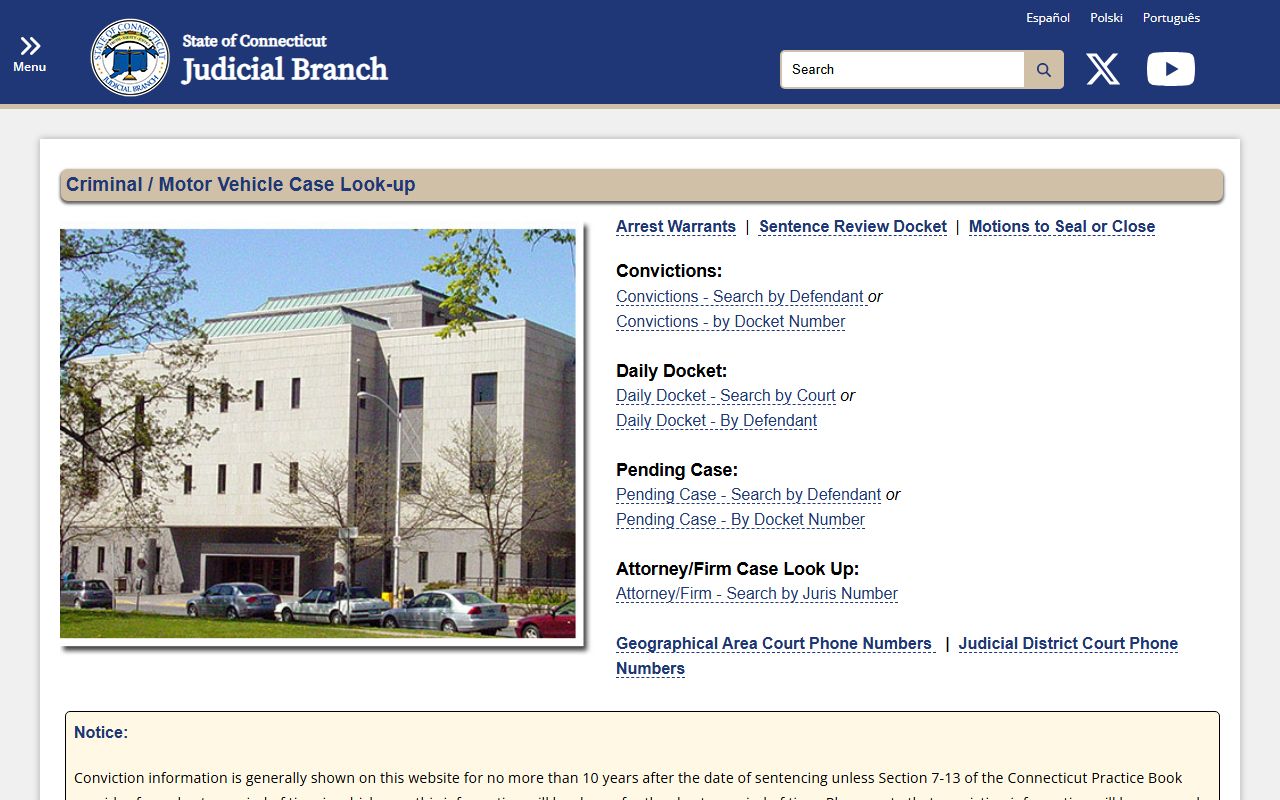
From that page you can read the docket, the charges, the bond status, and the next hearing date for a Fairfield County case. Use these steps to find the charges that follow an arrest.
- Open the Criminal/Motor Vehicle Case Look-up and pick pending cases or conviction/bond-forfeiture dispositions.
- Search by defendant last name and first name, or by docket number when you have it.
- Open the matching case and read the full charge list, the statute numbers, and the court location.
- Check each charge's current status, the bond, and the next scheduled court date.
For a statewide criminal-history check, the court look-up is not the final word. The Division of Criminal Justice does not provide criminal records, and its criminal records page routes people to the State Police, the Judicial Branch, and the DOC. Use the court portal for one case, and the official criminal-history channels for a formal record check.
Court Lookup Searches After an Arrest
The Criminal/Motor Vehicle Case Look-up splits its searches by what you already know. A name search casts wide. A docket-number search lands directly on one case. The portal also lets you view all cases on a docket or schedule for a given court, which helps when you know the court date but not the docket. The table below lists the searches the portal offers for Fairfield County court records.
| Search / Page | Type | Required | Notes |
|---|---|---|---|
| Pending case by defendant name | Web search | Defendant last name | Finds pending cases and upcoming court dates. |
| Pending case by docket number | Web search | Docket number | Best when taken from court paperwork or an arrest record. |
| Cases by court docket / schedule | Web listing | Court, location, or date | Shows all cases on a docket or schedule for a court. |
| Convictions by defendant name | Web search | Name | Covers conviction and bond-forfeiture dispositions. |
| Convictions by docket number | Web search | Docket number | Direct lookup for a known disposed docket. |
Note: The court lookup separates pending matters from disposed ones, so a search that returns nothing under pending cases may still appear under conviction and bond-forfeiture dispositions.
Which Fairfield County Court Holds the Record
Fairfield County is split across several judicial districts. Major felonies are handled at Judicial District courts. Misdemeanors and lower-level felonies are handled at Geographical Area courts. The right court depends on where the arrest happened and how serious the charge is. Bridgeport Correctional Center, the main local custody facility, serves the Superior Courts of Ansonia, Derby, Milford, Bridgeport, Danbury, Norwalk, and Stamford. That service area maps the local court geography for a Fairfield County arrest.
- Fairfield Judicial District handles many Bridgeport-area serious criminal matters.
- Danbury Judicial District covers Danbury, Bethel, Brookfield, Newtown, Ridgefield, and nearby towns by assignment.
- Stamford/Norwalk Judicial District covers Stamford and Norwalk-area matters.
- Ansonia/Milford Judicial District reaches lower Fairfield and the New Haven border towns.
- Geographical Area courts handle many misdemeanors and motor-vehicle cases; Judicial District courts handle major felonies.
Knowing the court matters for finding the record. The docket number and the court location together point you to the clerk who holds the file. When the look-up shows a case, it names the court. That tells you which State's Attorney's office is prosecuting and which clerk to call for a certified copy.
The State's Attorneys Who File Charges
Connecticut does not use county district attorneys. Prosecutors here are State's Attorneys, one for each judicial district. Police arrest charges are only the starting point. The State's Attorney decides which charges proceed in Superior Court, and that office can amend, substitute, add, reduce, or nolle the original counts. The charges in the court record reflect the prosecutor's filing, not just the arrest paperwork. The four offices below cover the judicial districts that touch Fairfield County.
The official directory maps each district to its prosecutor. The Division of Criminal Justice judicial districts and State's Attorneys page lists the names and the districts they serve.
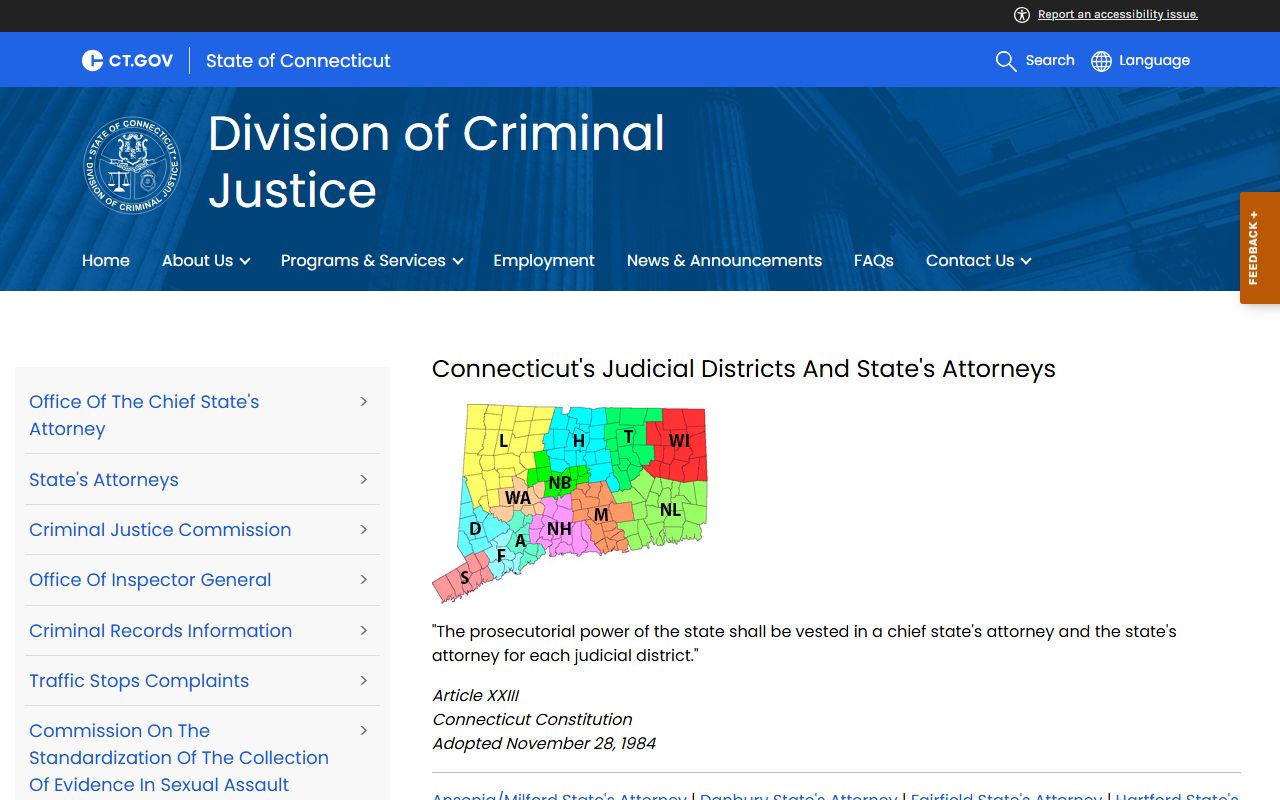
Use the district shown on the court docket to find the right office. The table pairs each Fairfield County judicial district with its current State's Attorney.
| Judicial District | State's Attorney | Appointed |
|---|---|---|
| Fairfield (Bridgeport) | Joseph T. Corradino | May 1, 2020 |
| Danbury | David R. Applegate | July 18, 2022 |
| Stamford/Norwalk | Paul J. Ferencek | May 1, 2020 |
| Ansonia/Milford | Margaret E. Kelley | September 26, 2018 |
The Division of Criminal Justice central office sits at 300 Corporate Place in Rocky Hill and can be reached at (860) 258-5800. That number is for agency contact. Individual case questions go through the court, the clerk, the assigned State's Attorney's office, or defense counsel.
How Charges Get Filed After an Arrest
The criminal process moves in stages. An arrest and booking come first. Then the charge record begins when the prosecutor files the charges that go forward. In Connecticut, the State's Attorney files and substitutes charges through the Superior Court process. A grand jury indictment is not the routine charging route for state cases. Federal indictments are a separate track entirely, handled in federal court. The table compares the arrest charges, the charges the prosecutor files, and federal indictments.
| Arrest Charges | State Charges Filed | Federal Indictment | |
|---|---|---|---|
| Set By | Arresting police | State's Attorney | Federal grand jury |
| Where | Police / booking paperwork | Connecticut Superior Court | Federal court |
| Look Up | Arresting agency | Judicial Branch case look-up | Federal court / PACER |
The DOC locator may list a controlling offense or a bond amount. That is a custody field, not the full charging instrument. For the formal charge status and disposition, the court docket is the better source. Federal matters do not appear in the state look-up at all. Those route through federal court, PACER, the Bureau of Prisons, and the U.S. Marshals Service instead.
Charge Status in a Fairfield County Court Record
Charges shift as a case moves. The booking charges on the custody side can differ from the charges the prosecutor finally files. A count can be amended, reduced, added, dropped, or dismissed. The court docket carries the current status for each charge. Reading those terms correctly keeps an arrest record from being misread as a conviction. The table defines the status terms a Fairfield County court record commonly shows.
| Status | What It Means |
|---|---|
| Pending | The case is open and not yet resolved. |
| Nolle prosequi | The prosecutor declines to proceed; erasure timing may apply after a statutory period. |
| Dismissed | The court has dismissed the charge or case; erasure rules may apply. |
| Not guilty / acquitted | A finding or verdict in the defendant's favor; erasure rules may apply. |
| Convicted / guilty | A judgment of guilt has been entered. |
| Amended / reduced | The prosecutor or court changed the charge from the original arrest charge. |
| Bond forfeiture | A court action tied to a failure to appear or a bond condition. |
A court case record also carries identifying detail. It shows the defendant name when public, the docket number, the court location, the charge and statute, the arrest or offense date, the plea or disposition, the bond status, and the scheduled court dates. Those fields are the heart of a court record after an arrest.
Bond After a Fairfield County Arrest
Bond is a release condition, not a finding of guilt. After a Fairfield County arrest, police may set a bond before court. If the person cannot post it, Judicial Branch bail staff may get involved. Bail staff are court personnel, not defense counsel. The Judicial Branch Bail FAQ explains the main release routes. A person can post the full cash value, use a ten-percent cash option when allowed, or hire a licensed bondsperson for a non-refundable fee. The ten-percent option applies only to eligible bonds of $20,000 or less when the court or police impose it.
| Bond Type | How It Works |
|---|---|
| Promise to appear | Nonfinancial release on a promise and conditions, with no money bond. |
| Full cash bond | The full amount is posted with the court or an authorized official. |
| Ten-percent cash option | Ten percent of an eligible bond of $20,000 or less, when the court or police impose it. |
| Surety bond | A licensed bondsperson posts the bond for a non-refundable fee or collateral. |
| Property bond | Real property is pledged under Conn. Gen. Stat. Section 54-66 when allowed. |
| No-bond hold | No release on that case or hold, common with serious charges or a detainer. |
To post a bond, first confirm the case and the custody status. Use the DOC inmate search for custody and the court look-up for the case. Then verify the bond amount and conditions with the court, facility, or bail staff rather than a stale web result. Ask which option the bond allows. If you use a bondsperson, confirm the license. The Department of Emergency Services and Public Protection covers professional bail bondsmen licensing, and the Insurance Department handles the surety bail bond license. A court can keep, modify, reduce, increase, or revoke a bond, and breaking release conditions can lead to a new charge or a revoked bond.
Note: Official facility pages do not publish a cash-bond desk or posting hours for Bridgeport Correctional Center, so confirm the posting location and accepted method with the court, facility, or bail staff before bringing any payment.
Fairfield County Arrest Warrants
A warrant is a court or judicial order that authorizes an arrest or another action. Several types can put a person into custody. An arrest warrant authorizes arrest on a criminal complaint. A bench warrant or capias often follows a missed court date and can trigger a rearrest. A search warrant authorizes a search but is not itself a custody record. A fugitive warrant ties to another jurisdiction or a federal task force. Connecticut has no county sheriff warrant list for this topic, so checking runs through the courts, the police, and the DOC.
- Start with the Judicial Branch criminal help page, which links case look-up, bond money, records, and active-warrant resources.
- Check the court case look-up and the clerk where the case is pending for a bench warrant or capias.
- Contact the arresting or investigating police department for a police arrest warrant, using official numbers only.
- Once booked into DOC custody, search the inmate locator for the current custody status.
Federal warrants and fugitive matters run through the U.S. Marshals. The District of Connecticut lists a Bridgeport office at (203) 579-5897 and the New Haven headquarters at (203) 773-2107. There is often a lag between a warrant arrest and the public DOC update, so the court and police may know a custody status before the locator reflects it.
Charges vs. Convictions in Fairfield County
Being arrested and charged is not the same as being convicted. A charge is an accusation. A conviction is the outcome after a plea or a verdict. The court record shows both stages, so reading the status is essential. The DOC also flags an accused status that is not a conviction, because Connecticut holds pretrial and sentenced people in the same statewide system. The table below contrasts a charge with a conviction.
| Charge | Conviction | |
|---|---|---|
| Stage | Accusation | Verdict or plea |
| Burden of Proof | Probable cause | Beyond a reasonable doubt |
| DOC Status | Accused | Sentenced |
| Public Record | Yes | Yes |
This matters when a custody result and a court result point in different directions. A DOC record showing accused status does not prove guilt. A court docket showing a pending case has not resolved anything yet. Only a conviction entry, a plea, or a verdict settles the question, and the court file is where that outcome lives.
Erased Court Records After an Arrest
Connecticut does not use the word expungement the way many states do. It uses erasure. Under Conn. Gen. Stat. Section 54-142a, records get erased for cases that were dismissed, nolled after the statutory period, ended in acquittal, were pardoned, or qualify under clean-slate rules. Section 54-142t adds automated erasure and an agency duty to assist with the process. Erasure changes public access to the record, so a once-visible case may no longer appear in a public search. The table contrasts a public court record with an erased one.
| Public Court Record | Erased Record | |
|---|---|---|
| Public Access | Open to search and inspection | Removed from public access |
| Applies To | Pending and convicted cases | Dismissed, nolled, acquitted, pardoned, clean-slate |
| Legal Basis | Connecticut public-records law | Conn. Gen. Stat. Section 54-142a and 54-142t |
Erasure does not mean a record was destroyed in every sense. It limits who may see it and how it may be used. For a dismissed, nolled, or acquitted case, the route to clearing the public record runs through Connecticut erasure law, the court, and the arresting agency. It does not run through reputation-management vendors. Those sites are outside official control and should not be relied on.
Older and Certified Fairfield County Court Records
The online look-up covers current pending cases and disposed dispositions. It is not a full archive. For older records, certified copies, or files that do not appear online, the clerk's office for the court that heard the case is the right contact. The Judicial Branch law librarians can also answer how-to questions. The criminal records help page explains how to obtain court records and what each channel handles.
Some court records carry access limits. Juvenile and youthful-offender matters are restricted. Victim-protected and witness information may be redacted. During a pending prosecution, Conn. Gen. Stat. Section 1-215 defines what arrest-record information is public and sets limits on the rest. Copy fees fall under Section 1-212, and the general public-records rule under Section 1-210 makes agency records public unless an exemption applies. Use the docket number when you ask a clerk, because it points straight to the file.
Note: A clean court search does not always mean nothing exists, since erased records, juvenile or youthful-offender files, and pending-prosecution limits can keep a case out of the public look-up.
Background Checks and Court Records
A casual court look-up is not the same as a regulated background check. The court portal answers questions about one case. A formal criminal-history check for employment or licensing runs through different channels. The Division of Criminal Justice does not provide criminal records and points people to the State Police and the Judicial Branch instead. Official criminal-history checks go through those agencies, not through a single-case court search.
Important: This is an independent reference site, not a consumer reporting agency under the FCRA, so nothing here may be used for hiring, credit, insurance, or tenant decisions.