
No Fairfield County Mugshot Roster
There is no Fairfield County mugshot gallery. No county sheriff runs a jail here, and no county booking-photo page exists in official sources. Back in 1968, every county jail in the state was merged into a single system run by the Connecticut Department of Correction, and custody has worked that way ever since. The local "jail" for a Fairfield County arrest is a state correctional center, most often Bridgeport Correctional Center. That means the usual roster-with-photos model from other states simply does not apply.
The public custody tool is the Connecticut DOC Inmate Information Search, reached through the agency's inmate information page. That search confirms who is held and where. It is not documented as showing booking photos. So the honest answer to "where do I see a Fairfield County mugshot" is that no single site posts one. You check custody first, then ask the agency that took the photo. A booking photo is an arrest record. It is not proof that the person was found guilty.
What the Connecticut DOC Search Shows
The DOC search returns text fields, not a photo. It is the closest thing Fairfield County has to a roster, and it covers people in current state custody. The result tells you the person's location, status, and case-related dates. The photo field is the one most people ask about, and it is the one the official page does not document. Read the status field with care. Connecticut holds accused people who are awaiting trial in the same system as sentenced people, so a listing does not mean a conviction.
| Field | What It Shows |
|---|---|
| CT DOC Number | The unique inmate number; the cleanest search key when you have it. |
| Name | The public name of the person in DOC custody. |
| Date of Birth | Used to tell apart people who share a common name. |
| Latest Admission Date | The most recent date the person was admitted to DOC. |
| Current Location | The facility, such as Bridgeport CC or Garner CI. It is a point-in-time field and can change fast. |
| Status | The custody or legal status. Accused status is not the same as a conviction. |
| Bond Amount | May appear for accused, pretrial cases when one applies. |
| Controlling Offense | The offense driving the custody or sentence record. |
| Sentence and Release Dates | Sentence date, maximum sentence, maximum release date, and estimated release date for sentenced inmates. |
| Detainer | Flags another hold, such as a parole, federal, or immigration hold. |
| Booking Photo / Mugshot | Not documented on the official DOC search. Do not expect a photo on the public profile. |
Two groups are left out of the public DOC database on purpose. People held under Connecticut's Youthful Offender Statute do not appear. Neither do people held for federal immigration authorities. A blank result, then, can mean many things. It does not prove that no arrest took place.
Connecticut Arrest-Record Law
Connecticut treats public agency records as open unless a law makes them secret. That rule is the backbone of access here. For arrests, one statute does the heavy lifting. It spells out what the public "record of the arrest" must include while a prosecution is pending. The list is blotter-level: the person's name, address, the date, time, and place of the arrest, the offense, and the arresting officer or agency. The agency must also release at least one of the warrant application, the incident report, a news release, or a similar report.
That law has hard limits. It carves out protections for victims, for witnesses, and for juveniles. Records that have been erased fall away from public view. Law-enforcement-sensitive material can be held back. None of this creates a county mugshot website. A booking photo is treated as an agency record, so whether it comes out depends on the holding agency and the case status, not on a public photo feed.
Key Statutes:
Conn. Gen. Stat. § 1-210 - the general rule that public agency records are open to inspection or copying unless a state or federal exemption applies.
Conn. Gen. Stat. § 1-215 - defines the public record of the arrest during a pending case and sets limits for victims, witnesses, juveniles, and erased records.
Conn. Gen. Stat. § 1-212 - governs copies and copying fees when you request a public record from a police agency or the DOC.
Note: A booking photo released under these rules documents an arrest and intake event, which is a separate thing from any later finding of guilt in court.
How to Request a Fairfield County Booking Photo
A booking photo request works best when you first know who holds the photo. Municipal police often take the booking photo during arrest processing, so the city or town police department is usually the first stop. If the person later moved into state custody and the DOC created or holds an intake photo, the DOC's records office is the route. The steps below follow that order. They also flag where access limits commonly apply.
- Check the Connecticut DOC inmate search first to confirm whether the person is in state custody and at which facility.
- Identify the arresting agency. If a municipal police department made the arrest, it likely holds the booking or arrest photo.
- File a Connecticut FOI request with that police department. Include the person's full name, date of birth if known, the arrest date, the arresting agency, and any docket or incident number.
- If the photo is a DOC record, use the DOC FOI route described below instead of the police department.
- Expect limits when the case was erased, the person is a juvenile or youthful offender, a victim or witness is protected, or the prosecution is still pending.
Wording matters. A vague "send everything on this person" request invites delay. A sharper request gets a cleaner answer. The DOC online channel is the DOC GovQA records request portal, which the agency lists as the way to submit a Freedom of Information request.
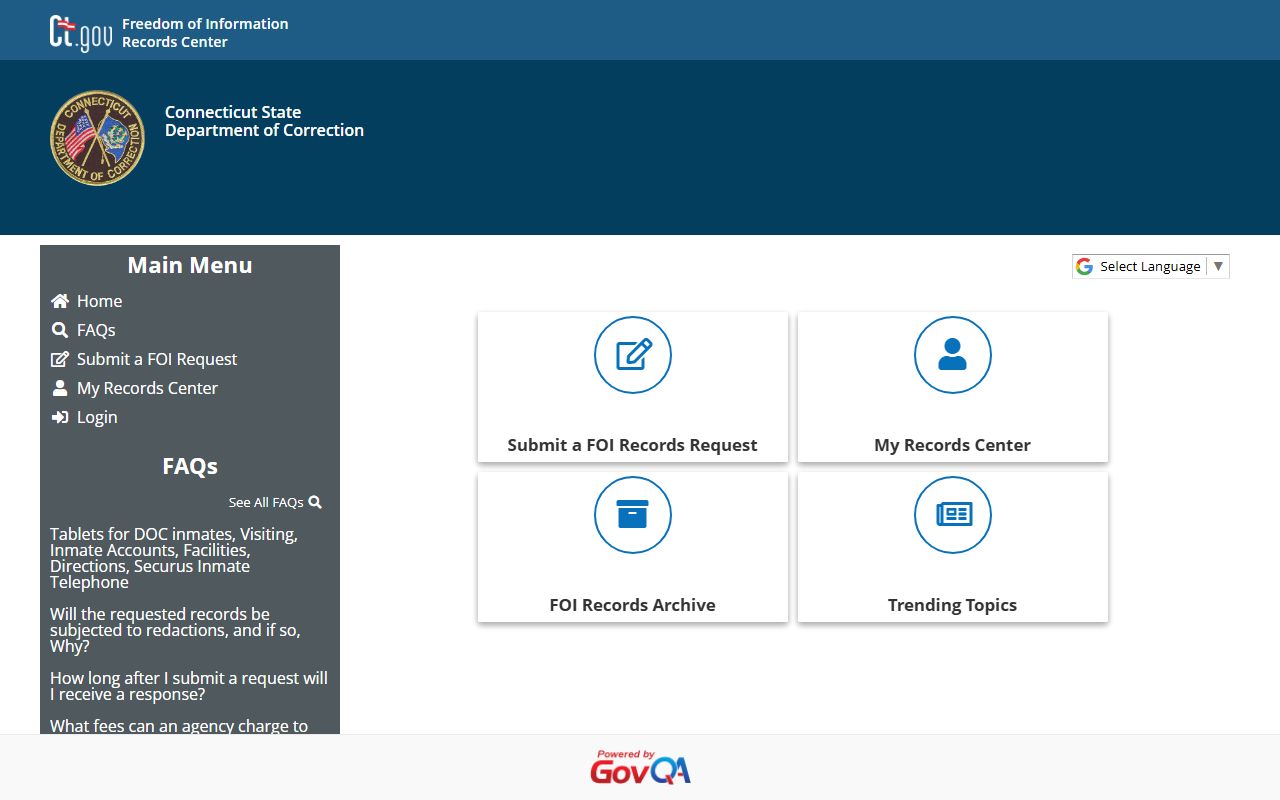
Through that portal you give your contact details, describe the record, and name the facility or inmate if known. A strong booking-photo request asks for "a copy of any publicly releasable booking photograph or intake photograph held by DOC for the named person, and if withheld, the statutory basis for withholding." That framing forces a clear yes, no, or legal reason, instead of silence.
The DOC Records and FOI Office
The Department of Correction runs a dedicated Freedom of Information office, and it is the catch-all for booking records, intake photos, and older custody information the inmate search does not show. The office coordinates the agency's compliance with Connecticut FOI law. It says it answers requests in a timely way as the law requires. It also handles real volume, taking in more than 3,000 records requests in an average year. The agency frames its work as being as transparent as it can be within the safety and security limits of running prisons.
The office can be reached online or by mail, phone, and fax. Its details appear on the DOC's External Affairs and Freedom of Information page, which also links the online portal.
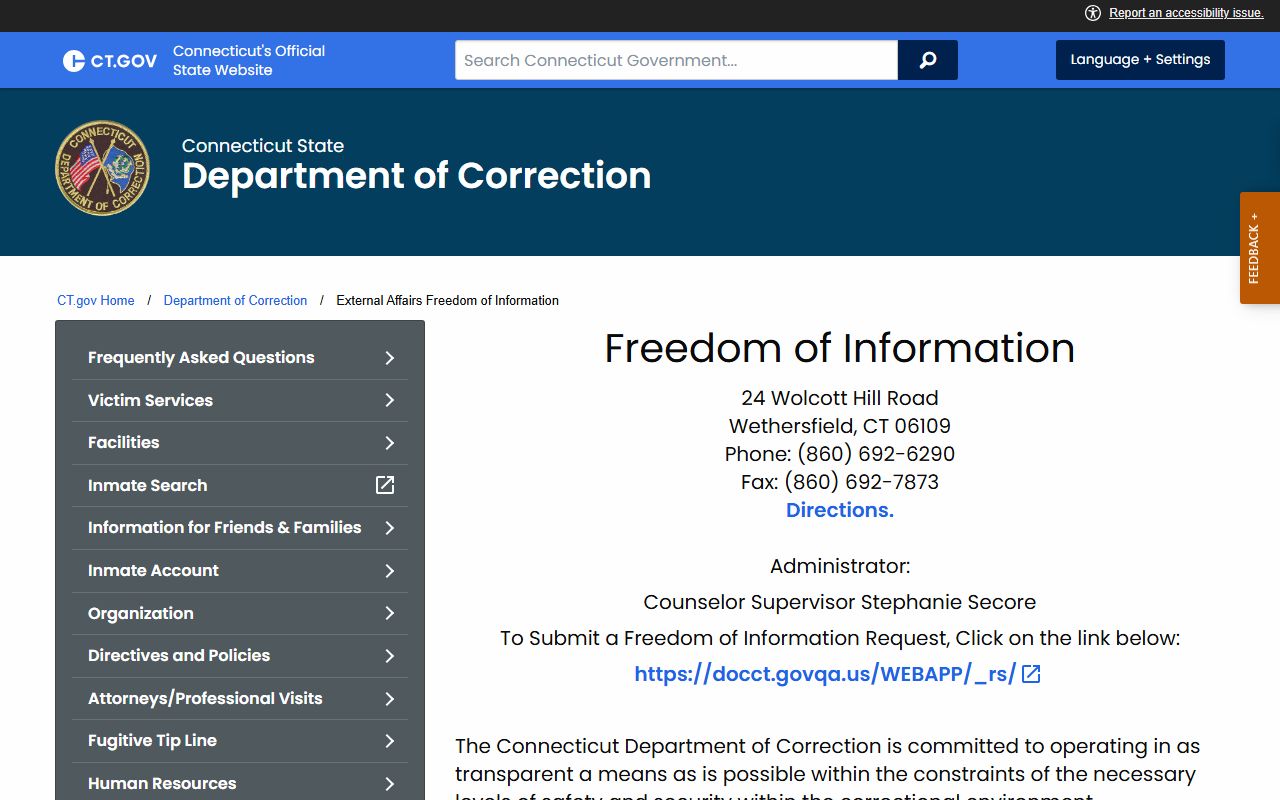
The office sits at 24 Wolcott Hill Road in Wethersfield. The FOI phone is (860) 692-6290 and the fax is (860) 692-7873. The page names Counselor Supervisor Stephanie Secore as the administrator. Use this office when a record is held by the DOC rather than by a local police department.
Note: For quick custody status rather than a formal record, the DOC Public Information Office at (860) 692-7780 answers calls Monday through Friday during business hours.
Why a Mugshot May Not Exist
A "no mugshot found" result is common in Connecticut, and it rarely means nothing happened. Several rules can keep a photo off public view. Erasure law removes dismissed, nolled, and acquitted records from the public side. Youthful offender and juvenile rules wall off young people's records. Victim and witness protections can redact or hold back material. While a prosecution is still pending, some content stays restricted. And federal custody runs on its own track entirely.
What is and isn't public: You can usually see a current inmate's location, status, and case dates through the DOC search, and you can request a releasable booking photo from the agency that holds it. You cannot expect a public photo gallery, and you will not get records that the law has erased, sealed for a juvenile or youthful offender, protected for a victim or witness, or withheld during a pending prosecution.
So the absence of a photo carries no meaning about guilt. It may reflect the case stage, the person's age, a protective rule, or simply the fact that no agency posts these images online. Confirm anything that matters with the office that holds the original record.
Removal and Connecticut Erasure Law
There is no county photo gallery to be removed from, so "mugshot removal" in Fairfield County is really a question about erasing the underlying record. Connecticut's erasure statute is the real tool. It governs records that were dismissed, nolled after the statutory waiting period, ended in a not-guilty finding, were pardoned, or qualify under the state's clean-slate provisions. When a record is erased, agencies must treat it as erased, which pulls the official arrest record from public access.
Erasure runs through the disposition of the court case, not through any private vendor. The right path is to confirm the case outcome and then rely on the holding agency and the erasure law. The court side of that process, including how a dismissed or nolled case clears, is covered on the court records after a jail arrest page. Third-party mugshot sites sit outside official control. They are not part of this process, and they are not linked or endorsed here.
Key Statute:
Conn. Gen. Stat. § 54-142a - erases dismissed, nolled, acquitted, pardoned, and clean-slate eligible records and requires agencies to treat erased records as erased.
Note: Erasure clears the official record, but a private website that copied a photo earlier is not bound by the state inmate search, which is why the lawful route is the holding agency and the erasure statute.
Federal and ICE Booking Photos
Federal custody does not offer mugshots either. The Bureau of Prisons inmate locator searches sentenced federal inmates by number or name, and its result template has no photo column. FCI Danbury sits in Fairfield County, but a search there returns text, not a booking photo. Federal pretrial custody runs through the U.S. Marshals Service, which keeps no public mugshot roster of its own.
Immigration custody follows the same pattern. The ICE Online Detainee Locator confirms whether someone is in ICE custody using an A-number or exact biographical details. It is a status tool, not a photo gallery, and it excludes people under 18. So across the federal and immigration systems, the custody lookups work for location and status, just not for photos.
These federal locators answer a different question than the state search does. They tell you whether a person is in federal or immigration custody, which the DOC database deliberately excludes. For the state roster side and how to read a custody record after a Fairfield County arrest, see the jail inmate records page. The Division of Criminal Justice criminal records page is also useful, since it routes formal criminal-history checks to the State Police and the Judicial Branch rather than to any photo site.